Seriously Addictive English — Complete Literacy Enrichment in Chicagoland
Discover a comprehensive literacy program engineered to sharpen the critical comprehension and analytical skills essential for your child’s lifelong success.
The Seriously Addictive English Program
The Preferred English Literacy Program of Chicagoland Parents
Our evidence-based reading and writing program for kids bridges the gap between fluent reading and deep understanding. Through a unique spiral structure, we empower students to analyze complex texts, write independently, and build the critical skills needed for lifelong academic success.
Ages 4 to 7
Develop fine motor skills and phonics skills to read, spell and write, and acquire vocabulary and early comprehension skills
Our research-based English literacy program empowers children to become confident, independent readers and analytical writers. Serving families throughout Chicagoland, we combine a structured literacy framework with the world-leading Cambridge English curriculum to accelerate progressive skill development far beyond standard grade-level expectations.
Our Six Pillars Approach of Literacy Mastery
01
An Individualized Starting Point
Diagnostic Assessment
The key insight: Every child arrives with a unique set of strengths and gaps. Meaningful progress starts only when we know exactly where to begin.
Stage 1
Phonic reading
Decoding accuracy and fluency
Stage 2
Phonic writing
Spelling and sound-symbol links
Stage 3
Reading comprehension
Meaning and text analysis
Stage 4
Free writing
Composition and expression
4-stage diagnostic assessment · Identifies strengths and gaps · Sets a fully customized starting point
⟶
No child is placed too high or too low — every student starts on solid ground
⟶
Gaps are identified before they become barriers to progress
⟶
Curriculum is tailored from day one, not retrofitted later
02
The "Little and Often" Routine
The Science of Memory
The key insight: Long learning sessions are inefficient. Short, consistent daily practice is how knowledge actually transfers into long-term memory.
The forgetting curve — and how we beat it
Without review, memory drops sharply within days. With daily short sessions, knowledge is consolidated into long-term memory.
15–20 min daily · 6 days per week · Knowledge transferred into long-term memory
⟶
Rooted in cognitive science — specifically Ebbinghaus’s Forgetting Curve research
⟶
Short sessions eliminate fatigue and maintain focus at its peak
⟶
Daily repetition over 6 days drives genuine retention, not surface-level recall
03
The Spiral Structure
Cumulative Mastery
The key insight: Skills are never “finished.” Each concept is continuously revisited in new contexts, deepening mastery with every encounter.
Knowledge consolidates with every revisit
Introduced first encounter
Reinforced in new context
Consolidated with varied application
Mastered independently applied
Small, manageable steps · Concepts revisited in varied forms · Confidence builds naturally
⟶
Replaces “cramming and forgetting” with steady, cumulative growth
⟶
Motivation stays high — students always feel progress, never stagnation
⟶
Knowledge compounds over time rather than being siloed by topic
04
Integrated Skills Over Isolated Drills
Connected Learning
The key insight: Reading and writing are not separate subjects. When skills are taught together, each one reinforces the others.
Reading
Spelling
Handwriting
Grammar & punctuation
One shared text becomes the thread: students read it → explore its vocabulary → examine its sentence structure → write their own original piece inspired by it.
All skills taught through the same text · Learning always feels connected, never fragmented
⟶
Skills reinforce each other — reading improves writing; writing deepens reading comprehension
⟶
Students see language as a whole, not a collection of disconnected rules
⟶
More engaging — content is always meaningful and contextual
05
The Pre-Comprehension Bridge
Text Detective Skills
The key insight: Reading fluency and comprehension are not the same skill. Understanding a text must be explicitly taught; this is why we run targeted reading comprehension classes for kids.
Stage 1
Retrieval
Locating explicit information directly stated in the text
Stage 2
Inference
Reading between the lines to understand implied meaning
Stage 3
Selection
Identifying the most relevant evidence to support an answer
Stage 4
Gathering evidence
Building a case by combining clues from across the text
Students become "text detectives" · Concrete strategies replace guesswork · Comprehension is taught, not assumed
⟶
Addresses the common gap: a child who reads aloud fluently but cannot explain what they read
⟶
Turns comprehension into a skill set, not a talent some children are born with
⟶
Builds the analytical foundation for every subject that involves written texts
06
Fostering Independence Through Self-Assessment
Ownership of Learning
The key insight: Students who can evaluate their own work become self-directed learners, a defining trait we nurture in our classes.
Complete work independently → Self-check against answers → Identify errors → Correct & reflect → Build deeper understanding
What this builds
Confidence to work without hand-holding
A growth mindset — mistakes are welcomed
Self-awareness about individual strengths
What it replaces
Waiting for a teacher to confirm every answer
Fear of being wrong or "not good enough"
Passive learning without genuine reflection
Child-friendly language · Visual icons for clarity · Self-assessment cycle embedded throughout the program
⟶
Students take genuine ownership of their progress
⟶
Error correction becomes an active learning moment, not a moment of shame
⟶
Prepares students for independent learning well beyond the program
What Children Learn
Approximate Age
Age 4-5
Ages 5 – 7
Age 8
Ages 9 – 11
Ages 11 – 13+
Key Focus
Developing fine motor and perceptual skills.
Acquiring the tools to read, spell, and write.
Gradual transition into understanding, responding to, and creating texts.
Understanding, responding to, and creating texts across a range of genres.
Becoming mature readers and writers.
Specific Skills Learned
Pencil control, pre-writing strokes, tracing, shapes, colors, and recognizing/writing letters and numbers 1-10. Includes Phonics Phase 1 learning through play, voice sounds, oral blending, and segmenting.
Phonics Phases 2-6: Learning the 19 most common single letter sounds, consonant/vowel digraphs, trigraphs, split digraphs, prefixes, suffixes, and past tense, and compound words.
Pre-comprehension tasks such as retrieval, inference, selection, and evidence to bridge the gap between fluent reading and poor comprehension. Introduction to independent writing focused on planning, spelling, grammar, vocabulary, and punctuation.
Completing comprehension tasks and writing narratives, non-fiction, instructions, poetry, and play scripts. Developing study skills like following examples, reading instructions, and thorough writing planning.
Engaging with complex text genres like modern myths. Advanced writing and grammar applications, including the use of figurative language such as similes and metaphors.
Transform Your Child’s Skills with the Best English Program in Chicagoland
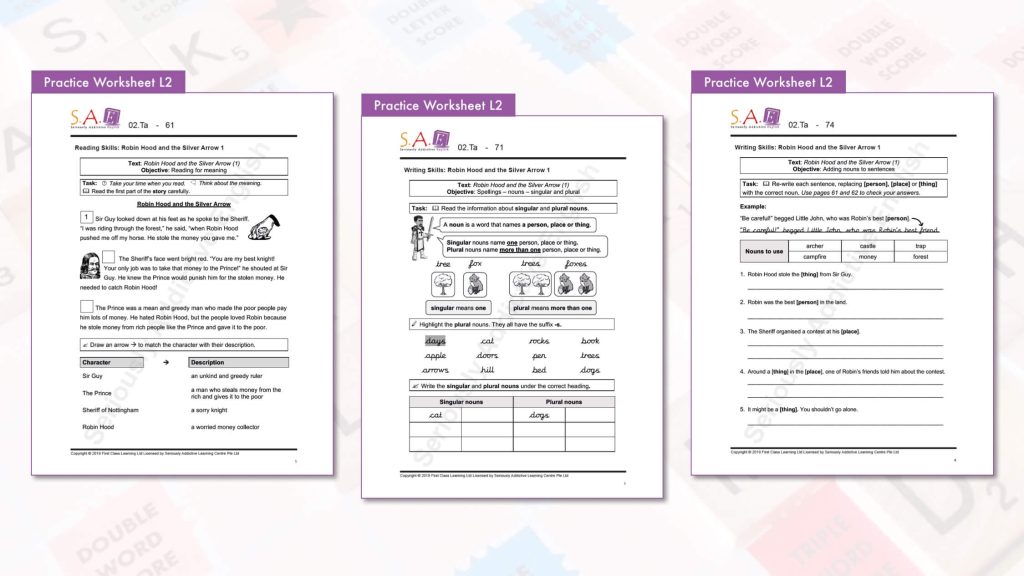
S.A.E worksheets are carefully structured to systematically develop reading and writing skills through a variety of activities and text types. Key areas are learned in gradual steps to ensure understanding and revised at increasing complexity.
Through guided practice in class and independent practice at home, children develop strong literacy skills, self-discipline and good study habits.
Individual Learning Plan
We use a comprehensive diagnostic assessment to pinpoint the skills a child has mastered and the skills the child needs more support with. Then, we prescribe a personalized learning plan tailored to each child at their own skill level and pace, because no two children learn alike.
In addition, we use the coaching approach with probing questions and a lot of encouragement to help students explore, discover and build confidence towards English.
SAE English curriculum overview by age group — four stages from ages 4 through 13
Motor & phonics foundation
Ages 4 – 6
Fine motor skills & early literacy
Fine motor skills
Perceptual skills
Oral blending & segmenting
Letter recognition
Phonics phases 1–2
Early handwriting
Sight words
Fluent readers
Ages 6 – 8
Reading, spelling & early writing
Phonics phases 3–5
Digraphs & trigraphs
Blending & decoding
Spelling patterns
Vocabulary building
Handwriting fluency
Early comprehension
Comprehension builders
Ages 8 – 10
Grammar, punctuation & text creation
Phonics phase 6
Prefixes & suffixes
Comprehension strategies
Grammar & punctuation
Spelling rules
Text types & genres
Structured writing
Advanced literacy
Ages 10 – 13
Independent writing & mature reading
Advanced comprehension
Planning & drafting
Independent writing
Critical text response
Complex vocabulary
Multiple text genres
Editing & proofreading
Common Questions (FAQ)
Answers to what parents ask most about our reading, writing, and comprehension program. We’re here to help you make informed decisions with complete clarity and confidence.
How does the Seriously Addictive English curriculum teach writing and grammar?
We don’t isolate grammar into passive definition lists or repetitive worksheets. We treat grammar as the structural architecture of clear thinking.
Students learn how sentence structure, punctuation, and syntax shape meaning, then immediately apply that knowledge in structured writing modules that connect reading and writing.
How are phonics and early literacy skills developed for younger students?
Our early-literacy approach uses systematic synthetic phonics. We break English into its 44 foundational sounds and guide learners through blending, segmenting, and letter-sound relationships. Combined with activities that build pencil control and fine motor skills, this helps children develop accurate pronunciation, independent spelling, and confident handwriting.
What makes your "spiral curriculum" structure more effective than school tracks?
Traditional programs introduce a concept once and move on, which leads to weak retention. Our spiral curriculum continuously revisits core literacy, vocabulary, and grammar concepts with increasing complexity. This cumulative reinforcement helps students build long-term mastery through consistent exposure.
What is the difference between a standard Reading Program and a Complete Literacy Program?
A standard reading program focuses mainly on decoding and fluency, which can leave students reading fluently but understanding little.
A complete literacy program integrates reading, spelling, handwriting, grammar, and punctuation, and explicitly teaches pre-comprehension skills like retrieval and inference. That bridges the gap to deep understanding and guides students to confidently plan and produce their own independent writing.
What is the Cambridge English framework, and how does it benefit my child?
The Cambridge English curriculum is an internationally recognized, structured English framework that emphasizes language-rich mastery over memorization drills. It moves students progressively from phonological decoding to sophisticated literary analysis. By organizing language into clear developmental phases, it helps children connect reading fluency, syntax, and analytical comprehension as they grow.
My child can read fluently. Why do they still need a comprehension program?
Mechanical decoding is not the same as comprehension. Many children read words quickly but cannot infer unstated context, analyze a character’s motives, or follow complex informational text.
Our comprehension lessons teach students to read analytically like detectives, extracting textual evidence, mastering vocabulary in context, and building critical-thinking habits.